
Hospitality First Board Dinner Seating Plan to Engineer Conversation

Use assigned seating for every board or executive dinner, keep the group to 8 to 15 people, and seat the primary host directly opposite or beside the lead decision-maker. Interleave support staff among principals rather than clustering them at one end. Then circulate a draft seating chart to the Chair and CEO’s office five days before the event and treat their corrections as final, no debate.
TL;DR:
Keeping guest counts between 8 and 15 preserves the dinner’s coherence, with 12 to 15 being ideal for intimate, meaningful dialogue.
Round tables encourage equal participation, whereas long rectangular tables support hierarchy and protocol, influencing conversation flow and staffing needs.
Circulate the seating draft five days before, finalize place cards and dietary information 48 to 72 hours prior, and prepare contingency plans for last-minute changes.
Seat the host either opposite or beside the Chair depending on event type, and interleave internal and external attendees to promote balanced, parallel conversations.
Employ a full-service event producer for high-stakes dinners to coordinate venue acoustics, seating, staffing, and last-minute adjustments seamlessly.
Table of Contents
Why Guest Count and Table Shape Decide the Whole Dinner
Eight to fifteen people is the range where a board dinner still functions as one conversation instead of three competing ones. Beyond roughly 15 attendees, side conversations start to splinter the room, and the Chair loses the ability to steer discussion without raising their voice or resorting to a microphone. That’s the ceiling worth protecting, not just a rule of thumb. Executive dinners that prioritize quality over headcount, according to CXO&Co’s guide to planning executive dinners, typically settle around 12 to 15 external attendees plus internal team members, which keeps the format intimate enough for real dialogue.
Table shape changes what that intimacy feels like:
Long rectangular tables create clear hierarchy, useful when protocol matters and the Chair needs a visible anchor point at the head.
Round or oval tables flatten hierarchy and are better when the goal is candid discussion among near-equals, such as an independent director dinner.
U-shape or boardroom configurations work for dinners that transition into a working session, since every seat has a sightline to a shared screen or presenter.
Each format carries its own staffing math. A long table for 15 typically needs a different server rhythm than a round table of the same size, since plates travel farther and pacing has to stay synchronized across two sides. Room selection, AV needs, and per-cover catering costs all shift with the shape you choose, so lock the format before you lock the venue.
Where Everyone Sits: A Seat-by-Seat Template
Start with the two anchor seats. On a rectangular or boardroom table, the Chair sits at the head, and the host sits either directly opposite or immediately to the Chair’s right, depending on whether the dinner is company-hosted or client-hosted. On a round table, there is no true head, so the host and Chair sit across from each other at the table’s visual center, the point most sightlines converge on.
From there, work outward in pairs. The CEO typically sits beside or near the Chair, close enough for private asides but not so close that the pairing reads as exclusionary to the rest of the table. Independent directors are spread rather than seated together as a bloc. Grouping them signals a divide between “management” and “oversight” that no one at the table needs reinforced over dinner.
The most effective placements interleave host-side and guest-side attendees so conversation runs in parallel lanes rather than splitting into two camps talking past each other. This kind of deliberate mixing is exactly the strategic use of seating that BizBash’s guide to smart seating strategies points to as a way to prevent dominant personalities from clustering and to bridge internal executives with outside directors.
A few practical rules round out the template:
Spouses and plus-ones sit adjacent to their principal, never directly across, unless protocol specifically calls for cross-table placement.
Dignitaries or protocol-ranked guests are seated by rank proximity to the host, not by personal familiarity.
A facilitator or note-taker sits at a corner or table end, close enough to hear everything, far enough to stay visually secondary.
Pro Tip: If you have two strong personalities who tend to talk over everyone else, seat them on the same side of the table rather than across from each other. Eye contact fuels competition; a shared sightline toward the rest of the group does not.
Handling Place Cards and Dietary Needs Without Drawing Attention
Place cards at this level of dinner do one job: guide a guest to their seat instantly, without hesitation, and without broadcasting anything about that guest to the rest of the room. Here’s how to build the system correctly.
Design cards for clarity, not decoration. First name and last name only, in a legible serif, no titles unless protocol specifically requires them.
Map every meal code to a seat number on an internal service sheet, never on the card itself. A guest’s dietary restriction should never be visible to the table beside them.
Collect dietary information early, ideally at the invitation stage, then reconfirm it 48 to 72 hours before the dinner. Preferences change, and allergies get missed on first pass more often than planners expect.
Brief venue staff on the seat-to-meal-code map before doors open, so the correct plate lands in front of the correct guest without a server pausing to ask or check a list at the table.
A related detail worth building into this same system: how you handle place card etiquette and meal codes at scale determines whether service feels effortless or visibly managed. The difference is almost always in the prep, not the room.
Designing the Room So the Table Talks, Not the Décor
The venue itself is a seating decision. Privacy, controllable acoustics, and unobstructed sightlines matter more than architectural drama. As Hyatt’s guide to choosing a corporate event venue puts it, the best room for this kind of dinner is “excellent and forgettable,” a space that supports the conversation instead of competing with it.
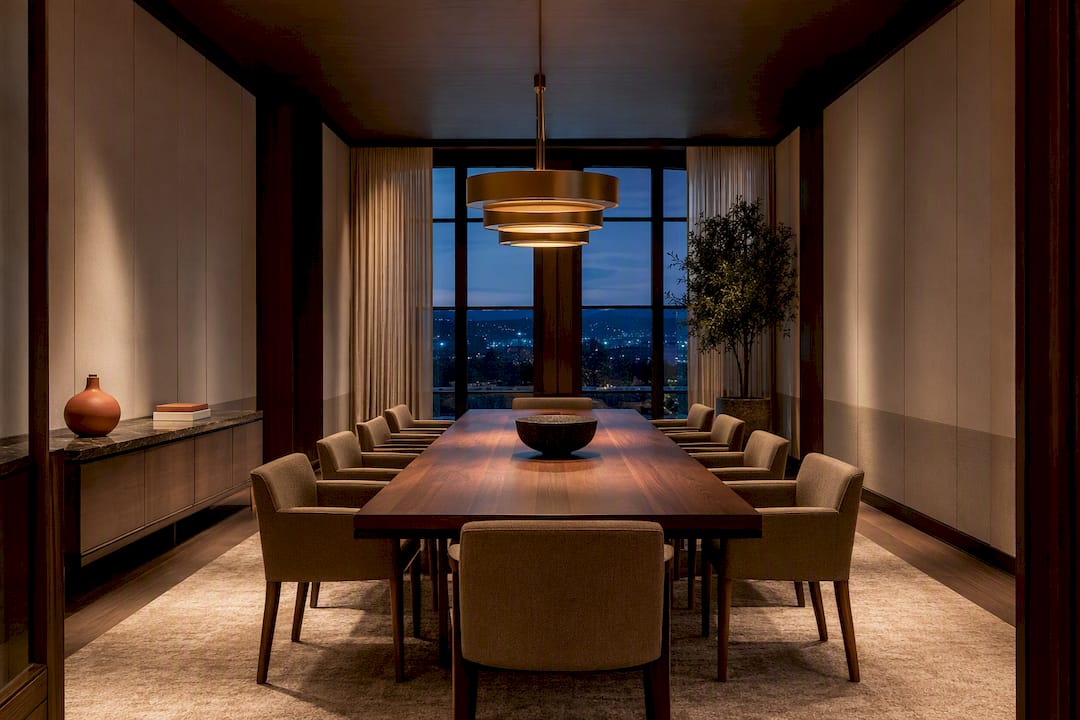
Pro Tip: Walk the room at the exact hour your dinner starts, not earlier in the day. Evening light, ambient noise from adjacent spaces, and HVAC hum all behave differently after dark.
Centerpieces are the most common way hosts accidentally sabotage their own sightlines. Keep arrangements low and narrow, or elevate florals on a clear glass riser so eye contact travels freely across the table. According to Meetings & Conventions’ guidance on seating design, obstructed sightlines are one of the most preventable failures in formal dinner seating, and they’re almost always caused by décor chosen for photographs rather than conversation.
A few more service-flow essentials:
Brief servers on pacing before doors open: courses should land in a synchronized rhythm, not staggered by table side.
Pour beverages and coffee discreetly, without interrupting whoever is speaking.
If remarks are planned, use a lapel mic and a modestly sized screen. Anything larger competes with the room’s intimacy.
Board and executive dinners work best around 12 to 15 external attendees, a scale small enough for one continuous conversation and large enough to justify the production behind it.
The Final Seven-Day Countdown Before the Dinner
Five days out: Circulate the draft seating chart to the Chair’s office and the CEO’s EA separately. Accept their corrections without debate. These edits often reflect confidential relational dynamics you’re not positioned to see from the outside.
48 to 72 hours out: Reconfirm every dietary restriction, finalize and print place cards, and prepare service sheets with the seat-to-meal-code map. Print two spare cards for last-minute additions.
The morning of: Verify the room in person or by current photos, brief every usher and server on the final chart, and print backup copies of the seating list.
On the day: Give ushers a short arrival script, confirm the arrival flow from entrance to table, and assign one person ownership of the contingency seating plan in case of a late cancellation.
Pro Tip: Print one extra full set of place cards in a sealed envelope labeled “spares.” A last-minute plus-one or a name misprint should never become a five-minute scramble in front of guests.
When Plans Change: Late Swaps, Security, and Cultural Protocol
Even a flawless chart needs a contingency plan. Keep a short backup guest list with pre-assigned seats ready to activate the moment a cancellation comes in, so a gap at the table never becomes visible to other guests.
For high-profile attendees, arrange a private entrance separate from general arrival, and set clear photography rules before anyone sits down.
When guests come from different cultural backgrounds, research hierarchy and greeting norms in advance. Seniority-based seating matters far more in some traditions than others.
Trained ushers and a clear seating list are what let a room seat a large group quickly and absorb last-minute changes without visible friction, a point echoed in Protocol Bureau’s guidance on managing seating arrangements.
If the dinner rolls into a working session, use a brief break to move rooms or reset the table rather than trying to shift the mood mid-meal.
Why We Treat Seating as Relationship Engineering, Not Decoration
Most seating charts get built backward: names get slotted into a shape, and the strategy comes later, if it comes at all. We build it the other way. A board dinner’s seating plan is the single most consequential design decision in the room, because it determines who talks to whom, who feels heard, and who quietly disengages before the entrée arrives.
[Professional credentials and client testimonials illustrating event success are not included here]. What that experience confirms again and again: the complexity in this article, from place-card discretion to acoustic control, only holds together when one team owns venue, staffing, and seating logic together instead of stitching them from separate vendors.
— Bonnie Rae
When It’s Time to Bring in a Full-Service Event Producer
A full-service event producer ensures that every decision in this article, from acoustics to place cards to the five-day circulation rule, is executed by one accountable team instead of three disconnected vendors. A managed engagement makes sense the moment privacy is non-negotiable, the guest list includes protocol-ranked or high-profile attendees, or the stakes of one awkward table conversation outweigh the cost of getting expert help.
A full-service producer handles the parts that are easiest to get wrong under pressure: sourcing a venue with the acoustics and discretion these dinners demand, drafting and revising the seating chart itself, briefing ushers and servers on the exact seat-to-meal-code map, and holding a contingency plan ready for the inevitable late change. Staffing ratios matter here too. Bonnie Rae’s guidance on bar staffing for UHNW events reflects the same principle that governs seating: every ratio and placement decision should serve the conversation, not just the logistics.
If your next board or executive dinner carries real stakes, visit Bonnie Rae’s home page to start a bespoke proposal built around your guest list, your venue, and your protocol requirements.
Sources
FAQ
How many people should attend a board dinner?
Between 8 and 15 attendees keeps the conversation coherent as one dialogue instead of splintering into side discussions once the group grows past roughly 15.
Where should the host sit relative to the Chair or CEO?
The host sits directly opposite or immediately beside the lead decision-maker, with the exact position depending on whether the dinner is company-hosted or client-hosted.
How far in advance should the seating chart be finalized?
Circulate a draft to the Chair and CEO’s office five days before the dinner, then finalize place cards and service sheets 48 to 72 hours out after dietary reconfirmations.
Should independent directors sit together?
No. Spreading independent directors around the table rather than seating them as a bloc prevents an “us versus management” dynamic from forming before dinner even starts.
What table shape works best for an executive dinner?
Round tables flatten hierarchy for candid peer discussion, while long rectangular tables suit protocol-driven dinners, and U-shape setups work best when the dinner transitions into a working session.
Recommended
Comments