
Place Card Etiquette for Luxury: Meal Codes & Bonnie Rae's Checklist
Use place cards whenever a plated dinner, a large guest list, or a seating chart with real stakes is on the table. They give hosts control over who sits where, give caterers the information to serve the correct entrée without guesswork, and give every table the finished, photo-ready look formal events demand. What follows covers the wording, placement, timing, and design decisions that separate a seamless tablescape from a scramble.
TL;DR:
Using both escort and place cards is essential for large, formal events to efficiently direct guests and assign exact seats, preventing entry bottlenecks and service errors.
Place cards are crucial for plated dinners with more than 50 guests, VIPs, or accessibility needs, to ensure proper seating and meal delivery.
Consistent formatting, careful legibility testing, and early ordering are vital to avoid common mistakes such as misreading names or running out of cards during setup.
Discreet meal codes and clear placement improve service accuracy without compromising the aesthetic or guest privacy.
Respect cultural name conventions and hierarchy preferences when designing place cards for international or multicultural guest lists.
Table of Contents
Place Card Etiquette Basics: Place Cards vs. Escort Cards
The two get confused constantly, and the confusion causes real seating chaos on event day. A place card marks an individual’s exact seat at a specific table. An escort card only tells a guest which table to find, usually displayed on a table near the reception entrance, alphabetized for quick scanning. Formal receptions frequently use both: escort cards to route guests efficiently from cocktail hour into the dining room, place cards to seat them once they arrive.
The operational difference matters more than the semantic one. Escort cards keep foot traffic moving and prevent a bottleneck at the door. Place cards prevent the awkward hover once guests reach their table, wondering who sits next to whom.
Use escort cards alone for receptions with open seating within each table, buffet service, or family-style meals where exact seat assignment does not affect service.
Use place cards alone for smaller, single-table events where every guest already knows which table they belong to.
Use both for large, formal, plated dinners, which is the standard at most high-net-worth weddings and galas Bonnie Rae produces.
Skipping escort cards on a large guest list almost always creates a jam at the entrance. Skipping place cards on a plated menu almost always creates a mismatched-entrée mess mid-service.
When Place Cards Are Worth the Effort
Not every gathering needs seat-level assignments, and forcing the formality onto a casual event can feel stiff rather than considered. The decision comes down to service style, scale, and how much is riding on who sits next to whom.
Plated service. Caterers serving multiple entrée options need to know exactly who ordered what, and a seat-specific place card is the cleanest way to communicate that without a server interrupting dinner to ask.
Guest counts above 50. Beyond a moderate guest count, open seating tends to produce lopsided tables, awkward stragglers, and friend groups clustering while VIPs end up isolated.
VIP or honored guests. Executives, sponsors, and family patriarchs and matriarchs typically expect (and deserve) a seat chosen with intention, not chance.
Accessibility needs. Guests using mobility devices, or those who need proximity to an exit or restroom, benefit enormously from a pre-assigned seat rather than a scramble.
Complex family or corporate dynamics. Divorced parents, business rivals, or executives who should not sit near a particular colleague all call for deliberate placement.
Skip place cards for intimate dinners under 20, casual cocktail-style events, or any gathering where mingling is the point rather than the exception. Every place card adds cost, design time, and a staffing task for setup, so weigh that against the actual seating risk. For a backyard engagement party, the trade-off rarely pencils out. For a board dinner or a wedding reception for 200, it always does.
How to Write Place Cards: Names, Titles, and Meal Codes
Consistency is the single rule that matters more than any honorific debate. Zola’s etiquette guidance is direct on this point: pick one format and apply it to every card at the event, because a table where half the guests get “Mr. and Mrs.” and the other half get first names only reads as an oversight, not a style choice.
Formal format (weddings, galas, board dinners): honorific plus surname. “Mr. Daniel Whitfield.” “Dr. Renee Sato.” “The Honorable James Cole.”
Modern format (relaxed formal events): first and last name. “Daniel Whitfield.” “Renee Sato.”
Pronoun-sensitive format: use “Mx.” where a guest has indicated that preference, or default to first-and-last name, which sidesteps the issue entirely and reads as thoughtful rather than clinical.
Married couples with the same surname can share one card: “Mr. and Mrs. Daniel Whitfield.” Couples with different last names, or unmarried partners, each get full names on a single card or, better for plated service, individual cards: “Daniel Whitfield” and “Renee Sato” side by side. Emily Post’s etiquette guidance for modern printed items makes clear that guest comfort and name accuracy now outweigh rigid honorific tradition, so when in doubt, ask the guest how they want to be addressed rather than guessing.
Never write “and Guest” on a place card once the RSVP deadline has passed. Confirm the actual name.
Pro Tip: For children’s place cards, use first name only, in a slightly smaller point size, and seat them near a parent or designated guardian for plated service so the server knows to bring the kids’ menu without asking.
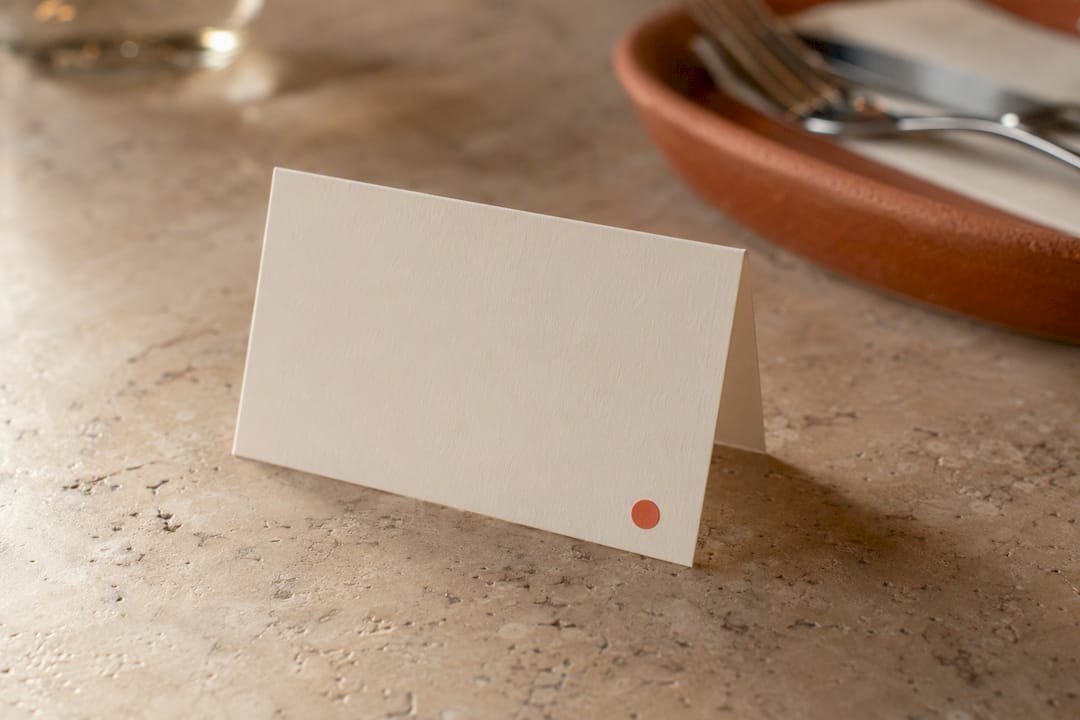
Meal codes solve the biggest hidden problem in plated dinners: how does a server know who ordered the beef and who ordered the branzino without asking at the table? Discreet indicators work best: a small symbol in the corner (a star for chicken, a circle for fish), a colored dot on the card’s reverse invisible from the guest’s seat, or a server-facing note on the back of a table’s floor plan. All three keep the mechanics invisible to guests while giving catering staff exactly what they need to execute service without a hitch.
Where Place Cards Go: Placement and Legibility
Placement decisions look small until a guest can’t find their seat during cocktail hour with a drink in hand and a room full of strangers watching. Three placements dominate formal tablescapes, and each has a best use case.
Top of the plate, centered on the charger: the most traditional option, elegant on camera, but it has to be moved before the first course arrives, so staff need a plan for where it goes.
Over the folded napkin: keeps the card visible and out of the way of service, a favorite for multi-course plated dinners.
In a holder, set just above the place setting: stands, clips, and mini easels add a decorative layer and keep the card upright through a long reception, though lightweight cardstock in a flimsy stand can tip with a breeze or a bumped table.
Legibility is where good design intentions quietly fail. Calligraphy looks stunning up close and unreadable from three feet away if the stroke weight is too thin or the ink lacks contrast against the card stock. Test any script font under the venue’s actual lighting, not a bright design studio, before committing to a full print run.
For the escort table itself, alphabetize by last name and post clear, visible signage so guests can self-serve quickly rather than crowding one table while staff field the same question repeatedly. Coordinate table numbers between the escort display and the place cards so nothing contradicts once guests sit down. If your reception includes a long communal table format, review how long table seating changes the etiquette around placement, since sightlines and spacing work differently than at round tables.
Ordering, Timeline, and Day-of Setup
Place cards fail for logistical reasons far more often than design ones. A late seating chart, an under-ordered print run, or nobody assigned to actually set the cards on the tables can undo weeks of careful planning in the final hour.
Finalize seating first. Nothing goes to print until the chart is locked, which typically means two to four weeks before the event for a guest list of any real size.
Order three to four weeks out, and add 10 to 15 percent extra cards beyond the confirmed guest count to cover last-minute additions and printing errors.
Keep a stack of blank cards and a calligraphy pen on-site. Guest counts shift right up to the day of the event, and a coordinator who can hand-letter a name on the spot avoids an empty, unassigned seat.
Book calligraphers early. Hand lettering for 150 to 300 cards takes real time, and reputable calligraphers book out months in advance for peak wedding season. Request a sample approval before the full run. Digital print using calligraphy-style fonts is a legitimate, faster alternative that most guests won’t distinguish from hand lettering at table distance.
Assign a specific setter. Whether it’s a coordinator or designated staff, someone needs a labeled seating chart, cards stored flat in a cool, dry place until setup, and a backup copy of the chart in case cards get shuffled during transport.
Choosing Materials That Match the Occasion
Paper stock and finish do more than decorate. They set the tone for the whole table before a single course arrives. Letterpress and blind embossing read as understated and tactile, catching light beautifully in photography without shouting for attention. Foil accents add shine that photographs well under low reception lighting, though heavy metallic foil can wash out under harsh flash.
Letterpress or embossed cotton stock: quiet, tactile luxury, ideal for weddings and galas photographed up close.
Foil-stamped cardstock: adds shimmer under evening lighting, best for cocktail-hour or evening receptions.
Nontraditional surfaces (shells, marble tiles, small mirrors): striking for destination or coastal events, but confirm size and stability first. A card that slides off a mirrored surface with the first breeze from an open door defeats its own purpose.
For events where discretion matters as much as beauty, blind-embossed meal icons, subtle stitched-edge accents, or muted color coding communicate meal choices to service staff without a guest ever noticing a code exists. That balance, beautiful to guests and functional for the catering team, is where luxury event design consistently separates itself from standard wedding stationery.
Solving Common Place Card Problems
Even a well-planned seating chart runs into edge cases, and how a host handles them says a lot about the event’s overall polish.
Dietary needs: encode them for staff only, never printed as text a tablemate can read. A discreet symbol protects a guest’s privacy while still guiding the server.
Accessibility: seat guests with mobility needs near aisles, away from tight chair spacing, and within easy reach of exits and restrooms without making the accommodation obvious to the rest of the table.
Last-minute plus-ones: keep blank card stock and a coordinator’s phone list on hand so an unexpected addition doesn’t mean an empty seat or a guest standing at a full table.
Privacy: never print allergies, medical conditions, or other sensitive details where any guest can read them. That information belongs on the coordinator’s working chart, not on the table.
Bonnie Rae’s Practitioner Checklist for High-End Seating
Executing seating flawlessly at an ultra-high-net-worth event comes down to discipline in the details most hosts never think to plan for.
Confirm every guest’s full legal name after the RSVP deadline. “And Guest” has no place on a place card once a name can be secured.
Lock meal selections at the individual level for plated service, not just a headcount by entrée, so the kitchen and service team can execute without a single query at the table.
Assign one person, a coordinator or a specifically briefed staff member, to place every card, and schedule a final walkthrough before doors open to catch any last-second seating change.
Stage a labeled backup set near the room in case a card is misplaced during setup or transport.
…
Place Card Mistakes That Undermine a Formal Table
Most seating disasters trace back to one of a handful of predictable errors, and every one of them is preventable with a little foresight.
Mixing formats across the table. One card reading “Mr. and Mrs. Smith” next to another reading “Jake” looks like an oversight, not a design choice. Pick one register and hold it across every card.
Printing “and Guest” after RSVPs close. Once a final name is available, use it. It signals that the host paid attention.
Skipping the legibility test. A stunning calligraphy font that no one can read from across the table defeats its own purpose. Print a sample and view it from a real seat before finalizing the order.
Under-ordering. Guest counts shift within the final two weeks more often than hosts expect, and a shortfall on the day of the event is far harder to fix than a few extra blank cards would have been.
No assigned setter. Beautiful cards do nothing sitting in a box backstage. Someone needs explicit responsibility for placing every card correctly before doors open.
Publishing sensitive information. Allergy notes, medical details, or anything a tablemate shouldn’t see never belongs on a printed card, no matter how useful it would be for the server to see it at a glance.
Ignoring accessibility until the day of. Seating a guest who uses a wheelchair at a table wedged behind other chairs is a fixable problem if caught during planning, and a scramble if caught at check-in.
Cultural Considerations for International and Multicultural Guest Lists
Formal seating etiquette carries different expectations depending on the cultural backgrounds represented at the table, and a host with international guests benefits from thinking through a few of these before printing anything.
Honorific expectations vary widely. Many East Asian, Middle Eastern, and South Asian cultures place strong weight on using full formal titles, professional credentials, or family honorifics correctly, where a first-name-only American convention can read as overly casual or even disrespectful. When in doubt, ask a host contact or the guest directly how they prefer to be addressed rather than assuming.
Name order matters, too. Guests from cultures where the family name precedes the given name (common across parts of East Asia) may have that order reversed on a card modeled on Western convention, which is an easy, avoidable error that shows up more often than it should. Confirm the intended reading order at the RSVP stage for any guest whose name doesn’t follow a Western first-then-last pattern.
Some cultures place high importance on seating hierarchy at formal meals, elders or ranking family members nearest the host, for instance, which can shape the seating chart itself well beyond simple wording choices. A thoughtful place card system respects those expectations rather than defaulting to a single cultural template and hoping it fits everyone at the table.
Why Etiquette Purists Get Place Cards Half Right
The old rulebook on place cards treats formality as the goal: correct honorifics, rigid title order, uniform script. That rulebook isn’t wrong, but it’s incomplete. The actual purpose of a place card is hospitality, not protocol for its own sake. A perfectly formatted card that misspells a guest’s name or forces an unwanted title onto someone who goes by something else fails at the one job the card actually has.
The gap in most etiquette guidance is operational, not stylistic. Wording templates are everywhere. Guidance on how meal codes actually reach a server’s hand mid-service, how a coordinator manages a last-minute plus-one, or how a setter physically places 200 cards correctly in a 30-minute window before doors open, is rare. That’s where formal events actually succeed or fail.
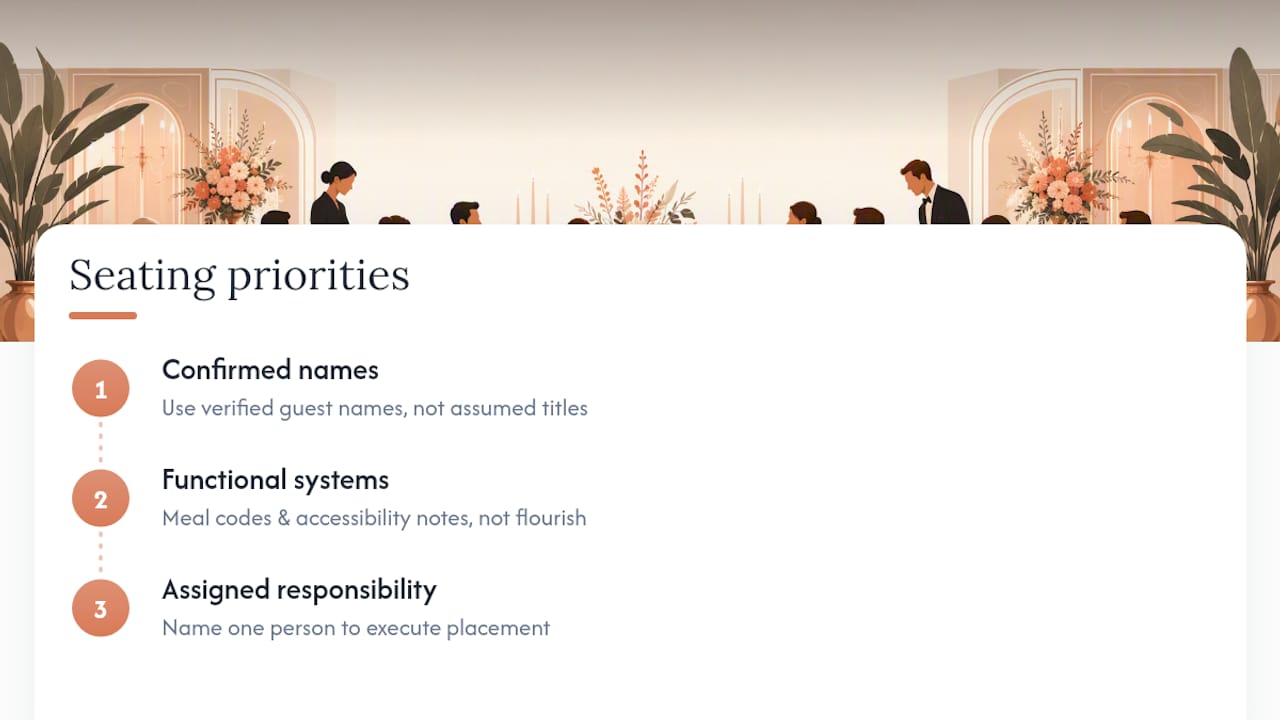
Prioritize three things in this order: confirmed names over assumed formality, discreet functional systems (meal codes, accessibility notes) over decorative flourish, and a named person responsible for execution over hoping the cards place themselves. Get those right, and the calligraphy is the easy part.
— Bonnie Rae
For hosts who want every seat, every card, and every course to land exactly as planned, Bonnie Rae designs and executes full-service seating programs, from stationery through day-of staffing, for weddings, galas, and executive dinners where nothing can be left to chance. Browse examples of past tablescapes and seating programs in the Bonnie Rae portfolio to see how thoughtful placement and design come together at the highest level of execution.
Sources
Recommended
Comments