
Contract Ready Valet Specs: Event Valet Planning for Luxury Planners
Updated: Sep 25

Event valet planning starts with one decision: define the scope of the arrival experience first, then shortlist vendors against a written checklist covering insurance, staffing, and site fit. Confirm the Certificate of Insurance with Garagekeepers coverage, a named on-site supervisor, and attendant counts matched to your arrival window before signing anything. Book two to four weeks out for events under 200 guests, and six to eight weeks ahead for anything larger or during peak season.
TL;DR:
Confirm that the valet vendor provides Garagekeepers coverage, named on-site supervision, and vehicle documentation protocols before signing a contract.
Build staffing ratios into the contract, with one attendant per 4 to 6 vehicles during peak arrivals, and have a backup plan for weather or volume surges.
Ensure the valet supervisor has direct communication with the event coordinator and security team through a dedicated channel to prevent confusion.
Verify that insurance certificates name the client as additional insured, include required endorsements, and are stored in event records for risk protection.
Prioritize administrative and safety checks such as insurance, supervisor, and staffing ratios over signage or uniforms to ensure smooth guest experiences.
Table of Contents
Assessing Event Fit and Venue Logistics
Vehicle volume rarely maps cleanly to guest count. A 150-guest wedding with staggered arrivals over ninety minutes moves through the curb far differently than a corporate gala where 200 executives arrive inside a 30-minute window after a keynote lets out. Estimate vehicles at roughly 0.6 to 0.8 per guest for private events, adjusted for rideshare use and out-of-town attendees who won’t be driving.
The physical site dictates almost everything else. Before requesting proposals, walk the property with these questions answered:
How many linear feet of curb space exist for active loading, and is it shared with catering or production vehicles?
Where does overflow parking sit, and how far is the walk back to the venue entrance?
Are there pedestrian crossing points that need cones, spotters, or temporary signage?
What’s the weather exposure at the drop-off point, and is there a covered staging option?
A wedding demands warmth and discretion at the curb. A gala needs speed during a compressed arrival surge. A conference needs consistency across multiple sessions and days. Each calls for a different staffing rhythm, and your vendor needs to hear which one applies before they quote.
Vetting and Contracting a Valet Provider
Treat vendor selection like any other high-stakes procurement, not a handshake deal. A reusable vendor comparison checklist built around event fit, staffing model, service-level expectations, risk and compliance, workflow technology, and commercial terms turns subjective sales conversations into something you can actually score. Shortlist two to four providers and send each the identical scope so the comparison is apples to apples.
Ask every finalist the same questions, in writing:
Can you provide a Certificate of Insurance naming us as Additional Insured, with Garagekeepers and Hired & Non-Owned Auto (HNOA) coverage?
Who is the named on-site supervisor for this event, and what is their experience with events of this scale?
What is your key-control protocol, and how do attendants document vehicle condition at intake?
Will you conduct a site visit before the event date?
The contract itself should spell out staffing counts by hour, arrival-readiness time, retrieval time windows, who supplies cones and signage, and cancellation terms with specific notice periods. A named supervisor and a completed site visit are the two clearest signals that a vendor is operationally serious. Their absence, especially for a large or high-profile event, is a red flag worth walking away from.
Pro Tip: Weight your scorecard so compliance and staffing carry more points than price. A cheaper bid that fails on Garagekeepers coverage or supervisor experience will cost far more if something goes wrong at the curb.
Staffing, Scheduling, and Backup Planning
Ratios matter more than headcount alone. For spaced arrivals, one attendant per 8 to 10 vehicles per hour is typically workable. When arrivals compress, as they do at galas where guests often cluster inside a 45-minute window, that ratio needs to tighten to one attendant per 4 to 6 vehicles to avoid a queue forming at the curb. A 250-guest gala running four hours with eight attendants typically costs within a moderate range depending on location and provider, providing a benchmark for sizing your own crew against budget.
Build these expectations into the contract itself:
A named supervisor with a documented backup in case of illness or scheduling conflict.
Meal-break rules that don’t leave the curb unstaffed during peak arrival.
A substitution clause requiring equal-or-better experience if the original crew changes.
A no-show remedy, such as a fee credit or guaranteed replacement within a set time.
Day-Of Execution: Staging, Retrieval, and VIP Protocols
The curb is a stage, and it needs to look like one from the first car to the last, with seamless coordination among hospitality teams detailed by Bridge PR. Get the layout right and everything downstream runs smoothly.
Set the physical footprint early. Cones, directional signage, and a covered valet stand should be in place at least an hour before doors open, with a weather contingency (tent or overflow indoor staging) confirmed in advance.
Choose your retrieval system deliberately. Paper ticketing still works for smaller events, but digital or text-based retrieval lets guests request their car from inside the venue, cutting the wait at closing and reducing the crowd bottleneck at the stand.
Pre-stage known departures. If you know certain guests are leaving early, for a flight or a media obligation, flag those vehicles to attendants in advance so retrieval is immediate.
Handle VIP arrivals with a discreet lane. A separate, unmarked entry point for principals and their security detail keeps recognition and photography to a minimum.
Follow a written impaired-driver protocol. Attendants should know exactly when to offer a rideshare, when to involve a supervisor, and how to document the interaction without escalating the situation.
Pro Tip: Give your valet supervisor a direct line to your day-of coordinator, not a group text. A single point of contact during a VIP handoff or an impaired-guest situation prevents the kind of confusion that turns a minor issue into a visible one.
Insurance, Permits, and Risk Controls
Insurance is where most planners either overprotect themselves with paperwork nobody reads or underprotect themselves with a COI that says almost nothing. Neither serves you well.
Recommended working limits generally include Commercial General Liability at $1 million per occurrence and $2 million aggregate, Commercial Auto at $1 million combined single limit, and Garagekeepers coverage set higher for luxury or high-value vehicle events, per insurance checklists built specifically for valet operators. Umbrella coverage becomes worth requiring once guest count or vehicle value climbs.
Some municipalities won’t issue an event permit at all without specific coverage language. Seattle’s special-events policy, for example, can require Garage Keepers Legal Liability of at least $150,000 per vehicle and $500,000 per location before approval.
Before you sign off on a vendor, confirm:
The COI names you (or the client) as Additional Insured, with Primary & Non-Contributory language.
A Waiver of Subrogation is included if your venue or municipality requires it.
You’ve requested the actual endorsement PDF, not just the COI summary, since a memo alone doesn’t prove the endorsement exists.
Copies are stored in your event file, not just emailed and forgotten.
Post-Event Reporting and Reconciliation
The event isn’t finished when the last car leaves. A professional operator delivers a written report by the next business day covering total vehicles parked, hours worked, any incidents, and a tip-pool summary if gratuities were pooled.
Require these components before final payment:
Vehicle counts and staffing hours, matched against the contracted schedule.
An incident log, even if the entry is “none,” with photos where relevant.
Key-handling records for the shift.
Any claims paperwork initiated, since carriers typically expect notification within 24 hours of an incident.
Structure the final invoice against the original contract terms so overtime, if any, is itemized rather than bundled, and build a dispute-resolution clause into the contract before the event, not after a disagreement.
Bonnie Rae’s Perspective on Luxury-Specific Requirements
At Bonnie Rae, we treat valet as guest experience design, not logistics on the side. That means polished, coordinated uniforms, a discreet arrival flow that never makes a principal feel processed, and attendant etiquette trained specifically around exotic and high-value vehicles.
A sample RFP line we recommend: “Supervisor must be named 14 days prior to event date; attendants handling vehicles valued over $150,000 require documented specialized training; all guest and vehicle information is confidential and non-disclosable.” Privacy protocols belong in writing, not assumed.
Communicating With Clients and Guests About Valet Service
Guests notice friction before they notice polish, so telling them what to expect matters as much as delivering it. Share arrival instructions in the invitation or event app: where to pull up, what the retrieval process looks like, and whether gratuity is included or expected separately.
For clients, set expectations early about cost drivers, staffing counts, and what happens if guest volume runs higher than the RSVP count suggested. A short pre-event call between the planner, the valet supervisor, and the client covering arrival timing, VIP handling, and weather contingencies eliminates most day-of surprises. Keep the tone warm rather than transactional. A line like “your guests will be greeted the moment they arrive, and their cars will be ready within minutes of a retrieval request” tells a client the experience has been designed, not just staffed.
For the guests themselves, signage and verbal cues at the stand should match the tone of the event: understated for a private dinner, warmer and more visible for a large gala. If a text-based retrieval system is in use, make sure the instructions are simple enough that a guest unfamiliar with the technology isn’t left standing at the stand wondering what to do next.
Contingency Planning for High-Volume Days and Bad Weather
Every valet plan needs a version B. High-volume events, think a gala where 300 guests arrive within the same 45-minute window discussed earlier, require a staffing buffer built in from the start, not added once the line starts forming. Ask your vendor to hold two or three on-call attendants who can be activated within 30 minutes if arrival volume exceeds projections.
Weather contingencies deserve the same specificity. A covered staging area isn’t optional in regions with unpredictable rain or heat; it’s a line item in the contract. If the forecast turns, confirm in advance who makes the call to activate tenting or move overflow parking closer, and how much notice attendants need to execute that shift without disrupting service.
Build a communication trigger into the plan: a specific guest-count threshold or weather condition that automatically activates the backup staffing plan, rather than leaving that judgment call to be made in the moment. This is where the written SLA becomes protective rather than bureaucratic. It tells everyone, planner, vendor, and client, exactly what happens if conditions shift.
Communication Between Valet Staff, Planners, and Security
Valet, security, and event coordination often operate as three separate teams that happen to share a curb, and that separation is where problems start. The fix is a shared communication protocol established before the event, not radios handed out at the last minute.
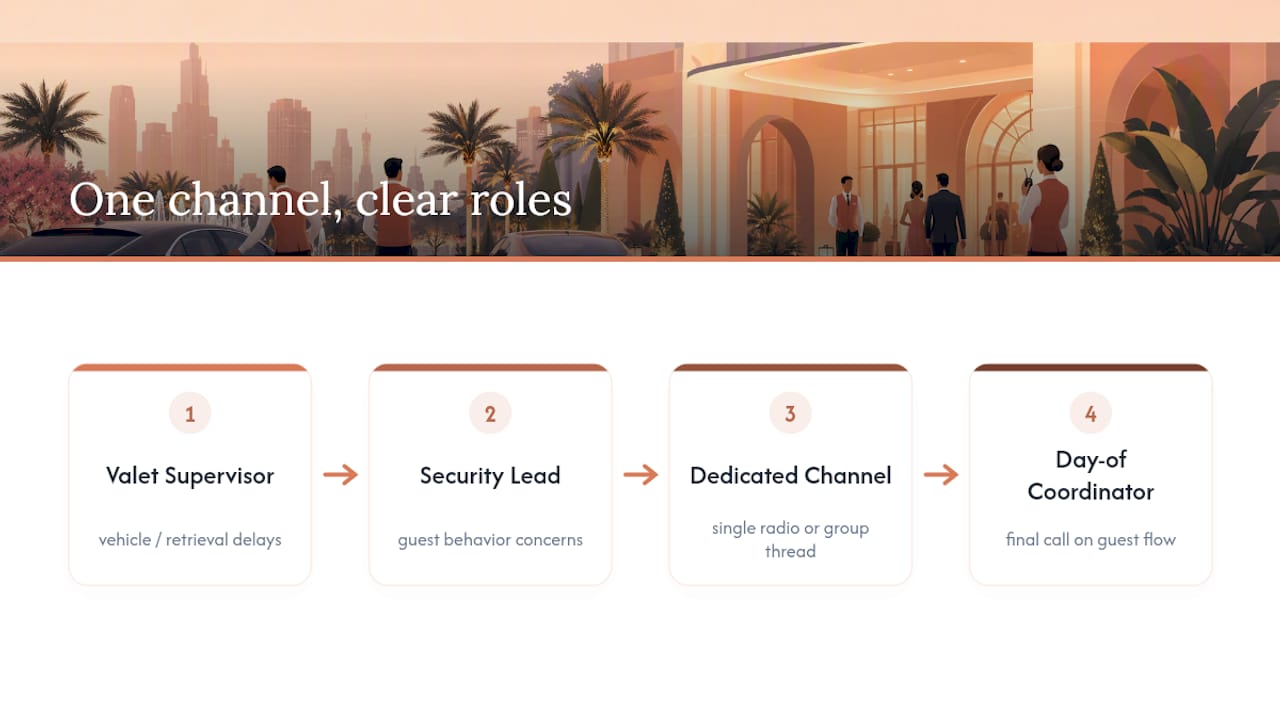
Designate one channel, ideally a dedicated radio frequency or group messaging thread, connecting the valet supervisor, the day-of coordinator, and the security lead. Establish who calls what: security flags any guest behavior concerns, the valet supervisor flags vehicle or retrieval delays, and the coordinator makes the final call on anything that affects guest flow. A private-event staffing approach that treats every guest-facing role as part of one coordinated hospitality team, rather than siloed vendors, tends to produce noticeably smoother arrivals and departures.
Pricing Structures, Overtime, and Hidden Fees
A valet quote that looks clean on paper can still surprise you at final invoice if the structure isn’t spelled out. Ask for pricing broken into base staffing hours, an explicit overtime rate for anything beyond the contracted window, and any equipment or travel fees separate from labor.
Confirm in writing whether gratuity is included in the quoted price, pooled among attendants, or collected separately from guests, since this affects both your budget and your guest communication. Ask specifically about minimum booking hours, since many providers set a four-hour minimum regardless of actual event length, and about cancellation fees tied to how close to the event date you cancel.
The goal is a quote you can read once and understand completely, no footnotes required when the final invoice arrives.
What Actually Separates a Smooth Curb From a Chaotic One
Most valet planning advice treats insurance and staffing as compliance checkboxes to clear before moving on to the “real” event design. That’s backwards. The curb is the first five minutes of the guest experience and the last five minutes of the memory they leave with. Get it wrong, and it colors how they remember everything that happened in between.
The conventional wisdom oversells technology, digital retrieval systems, license-plate recognition, and undersells the two things that actually prevent chaos: a named, experienced supervisor and a staffing ratio that matches your real arrival compression rather than your guest list’s average. A polished app means nothing if there are only four attendants working a 45-minute surge that needed eight.
Prioritize the boring paperwork first. Confirm the COI and Garagekeepers endorsement, name your supervisor, and set your ratios before you think about signage colors or uniform details. The luxury feel comes from what guests never have to notice, not from what impresses them at the curb.
— Bonnie Rae
Bring That Same Standard to Your Entire Event
Coordinating a checklist this detailed for one part of an event, valet alone, shows exactly why full-service production exists. If you’re managing insurance verification, staffing ratios, and vendor contracts for the curb, you’re likely doing the same juggling act for catering, florals, staffing, and guest experience design elsewhere in the event.
Bonnie Rae brings that same level of scrutiny, named supervisors, written SLAs, verified insurance, to every element of an event: venue scouting, catering, bar and sommelier programs, brand installations, and highly vetted staffing for ultra-high-net-worth private, celebrity, and corporate clients. Rather than coordinating a dozen vendors against a dozen separate checklists, one production partner carries that standard across the entire guest experience, from the first valet handoff to the final course served. If you’re planning a private, corporate, or celebrity event and want that consistency without managing every vendor relationship yourself, start a conversation with Bonnie Rae about your next event.
Sources
Recommended
Comments