
$350–$700 Per Guest: U.S. Luxury Event Floral Budget
The rule of thumb: for a corporate gala, budget $350 to $700 per guest for full-service florals, and let that number cascade into every line item before you request a single quote. Private estate dinners and brand activations follow the same logic at different scale, from roughly $1,500 for an intimate gathering to well past $50,000 for a multi-room gala, which is typical in a luxury vacation home wedding setting. The single best next step is to lock your florist’s calendar now. In premium U.S. markets, production capacity for peak dates disappears months in advance.
TL;DR:
Most luxury event floral budgets are between $350 and $700 per guest for full-service production, including design, labor, and logistics.
Labor costs typically account for 40 to 60 percent of the total and include design fees, crew hours, and union requirements.
Building a contingency reserve of 10 to 15 percent is essential to cover last-minute changes, stem shortages, and unforeseen expenses.
Booking three to four months in advance is crucial for large galas and peak-season dates to secure production capacity and favorable pricing.
Full-service floral production is recommended for large events with multiple vendors, while smaller gatherings may opt for à la carte arrangements to save costs.
Table of Contents
What Should an Event Floral Budget Look Like by Scale?
A useful event floral budget starts with scale, not sentiment. Luxury corporate floral spending in major U.S. markets generally clusters into four tiers, and knowing which one you’re in changes every conversation you have with a florist.
Small private dinners and estate gatherings of 20 to 60 guests typically run $1,500 to $5,000 total, enough for a statement tablescape and an entry moment without structural builds. Mid-scale events for 60 to 200 guests, think brand dinners or milestone celebrations, land between $5,000 and $15,000, according to corporate floral budgeting guidance from FlowerEver. Large galas of 200 or more guests start at $15,000 and climb past $50,000 once suspended installations or multi-zone staging enter the picture.
Event scale | Guest count | Typical total budget |
Small private/estate | 20–60 | $1,500–$5,000 |
Mid-scale corporate | 60–200 | $5,000–$15,000 |
Large gala | 200+ | $15,000–$50,000+ |
A per-guest frame of $350 to $700 sits comfortably inside that large-gala tier once labor, staging, and installation costs are folded in. Expect the top of every range in New York, Los Angeles, and Miami, where warehouse space, union crews, and building access add real cost before a single stem arrives.
What Actually Drives the Cost of Luxury Florals?
Ask any seasoned producer where the money goes, and the answer rarely starts with flowers. Labor and installation absorb the largest share of most luxury proposals, and the breakdown from Poppy Flowers puts labor at roughly 40 to 60 percent of total cost, with materials closer to 25 to 35 percent.
Statistic Callout: Labor, not flowers, is usually the biggest line on a luxury floral invoice. When a proposal quotes primarily for stems, ask what design and installation hours are actually included.
Four categories move the number most:
Labor and installation — design fees, on-site crew hours, and union labor requirements where the venue mandates them.
Stem selection and seasonality — imported or out-of-season blooms carry air freight and specialty premiums that shift week to week.
Structural builds — rigging, suspended installations, floral walls, and custom props, which the luxury wedding cost guide from Today’s Luxury Weddings prices at $10,000 to $100,000 or more for a single feature.
Operational overhead — refrigerated storage, dedicated transport, insurance, and contingency stems ordered to cover breakage.
Venue logistics compound all four. Freight elevator limits, narrow load-in windows, and union rules routinely push labor hours toward the upper end of that range in premium markets.
How Do You Allocate a Luxury Floral Budget?
Spend where guests actually look. That single principle should govern every dollar in a full-service floral budget, and it works whether you’re producing a 40-person dinner or a 400-person gala.
For a corporate gala, a workable allocation looks like this:
Entry and photo moments (25 to 35 percent) — the single most-photographed installation deserves the richest, rarest blooms.
Guest tables (20 to 30 percent) — repeatable, high-volume arrangements where design consistency matters more than rare stems.
Stage and program backdrop (15 to 20 percent) — visible in every photo and video clip, so it needs to hold up under lighting.
Bars and circulation spaces (10 to 15 percent) — smaller accents that keep the aesthetic continuous without competing for attention.
Contingency and refresh (10 percent) — held back for breakage, wilting, or last-minute changes.
The move that saves real money without cheapening the room: concentrate rare or labor-intensive stems in the two or three moments guests photograph, and use volume greenery and seasonal blooms everywhere else. Estate events and product premieres scale the same template. Multi-room activations simply multiply the “focal moment” allocation across each space rather than spreading a single fixed budget thin.
Pro Tip: Ask your florist to price the entry installation and the guest tables as two separate line items before finalizing the proposal. It’s the fastest way to see whether the “wow” moment is actually getting the investment it needs.
What Hidden Costs Inflate a Floral Quote?
The number on the first page of a proposal rarely reflects the final invoice, and the gap almost always comes from logistics rather than design.
Union labor and load-in windows — many premium venues require union crews for rigging and installation, and tight freight elevator schedules can add overtime hours fast.
Parking and staging for production vehicles — refrigerated trucks need dedicated access, and downtown venues often charge for it separately.
Cold chain integrity — an unbroken cold chain from farm to venue is what separates flowers that hold up for six hours from flowers that wilt by the second course, and specialized transport carries a real premium.
Overnight and multi-day maintenance — events spanning more than a day usually require a refresh visit, priced as its own labor call.
Peak-season surcharges — demand spikes around major holidays and gala season push both wholesale and labor pricing higher, a pattern documented in flower pricing volatility reporting from 2020 through 2026.
Book early to avoid the worst of it. FlowerEver recommends reserving florists six to eight weeks out for standard corporate events and three to four months ahead for large-scale galas, and production vehicle logistics deserve the same lead time as staffing. For events with heavy valet or vehicle coordination, detailed logistics planning prevents load-in bottlenecks before they become invoice surprises.
What Should a Luxury Floral Budget Template Include?
A proposal that skips line items is a proposal that hides costs. Every serious quote should itemize:
Line item | What it covers |
Design fee | Concept, sourcing, and creative direction |
Stems and supplies | Flowers, greenery, vessels, mechanics |
Install and breakdown labor | Crew hours on-site, before and after |
Delivery and transport | Refrigerated trucks, mileage, parking |
Rentals | Vessels, structures, specialty containers |
Rigging and permits | Suspended installs, venue sign-offs |
On-site maintenance | Refresh visits for multi-day events |
Contingency stems | Buffer against breakage and imperfect blooms |
Lay two vendor proposals side by side against this template and gaps surface immediately: a missing breakdown labor line, an unstated transport fee, or a contingency allowance that doesn’t exist at all. A conservative buffer of 10 to 15 percent above the base quote keeps a UHNW event from stalling over a last-minute stem shortage.
What Should You Ask Before Signing a Floral Proposal?
Before any signature, confirm these five things in writing:
What hours are included for delivery, installation, and breakdown, and what triggers overtime?
How is the cold chain maintained in transit, and is transport insured?
How many contingency stems are budgeted, and for which arrangements specifically?
What is the on-site staffing plan, including crew size and arrival times, and does it meet the venue’s union requirements?
What are the cancellation, rescheduling, and peak-season surcharge terms?
A florist who answers all five without hesitation has done this before at your scale.
How Do You Plan for Budget Contingencies?
Every luxury floral budget needs a built-in buffer, because the variables that move price most, weather-driven stem shortages, last-minute guest count changes, a venue that adds a load-in restriction three weeks out, are largely outside your control.
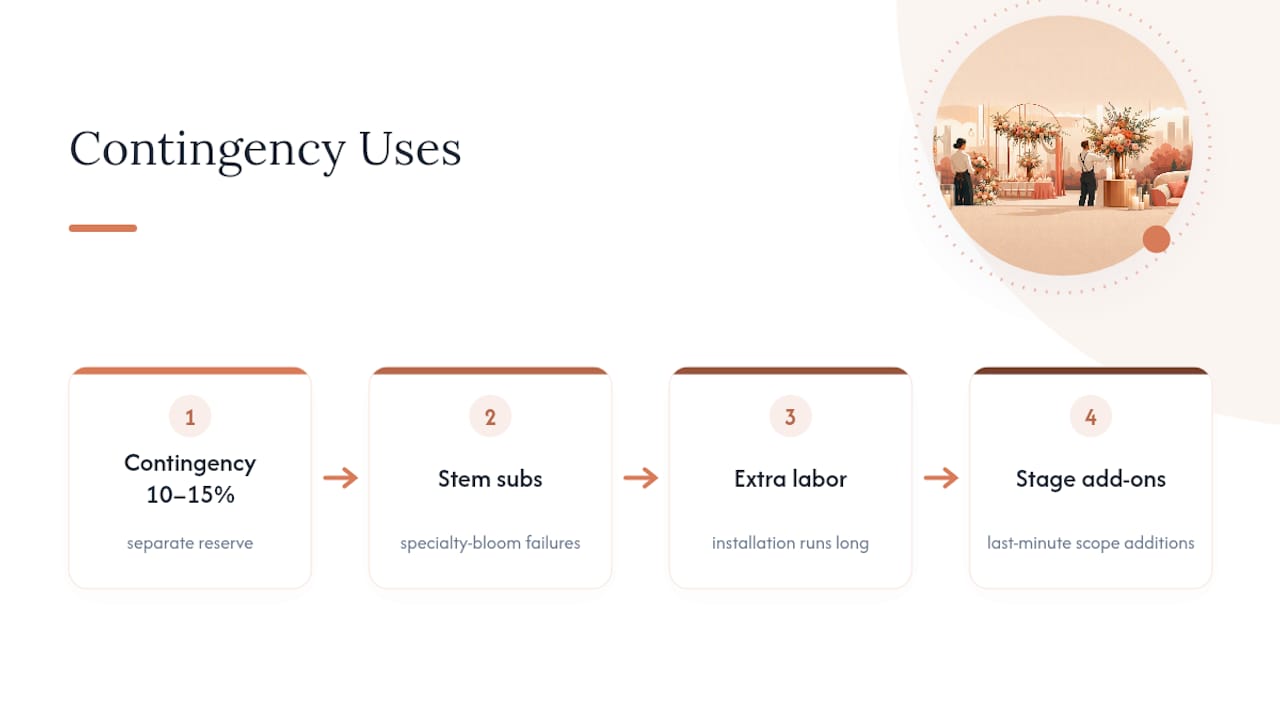
Set the contingency line at 10 to 15 percent of the total floral budget, held separately from the working budget rather than folded into “miscellaneous.” That reserve typically covers three scenarios: emergency stem substitutions when a specialty bloom fails to arrive, additional labor hours when installation runs long, and last-minute scope additions when a client decides the day before that the stage needs more presence than originally planned.
The florists worth hiring build a version of this buffer into their own sourcing, ordering extra stems as standard practice to guarantee perfect arrangements under production pressure. That’s a different reserve from your contingency line. Ask specifically whether their quoted price already includes an internal buffer or whether stem replacement would come back to you as a change order.
For celebrity and UHNW private events, add a second layer: a rapid-response clause allowing same-day adjustments if a guest list or venue detail shifts. This costs more to build into a contract, but it’s the difference between a florist who can pivot at 9 a.m. for a 6 p.m. event and one who cannot. Contingency planning isn’t about assuming failure. It’s about making sure a single supply hiccup never becomes visible to a guest.
Full-Service Production Versus À La Carte Floral Packages
À la carte packages, ordering centerpieces or a single installation piece without a broader production relationship, work for smaller, lower-stakes gatherings where the florist doesn’t need to coordinate with catering, lighting, staging, or venue logistics. The cost per piece often looks lower on paper.
Full-service floral production folds design, sourcing, installation, breakdown, and on-site maintenance into one accountable relationship, which matters enormously once an event involves multiple vendors working the same room on the same timeline. A florist working à la carte typically isn’t present to solve a load-in conflict with the AV crew or adjust an installation when the stage plot changes at the last minute. A full-service partner is.
For a 40-guest private dinner with no structural builds, à la carte can be the more efficient choice. For a corporate gala, a celebrity activation, or any event with multiple production teams sharing a footprint, full-service coordination isn’t a premium add-on. It’s what prevents a beautiful floral wall from being wheeled through a service corridor at the wrong hour and colliding with the catering timeline. The line-item template earlier in this guide works for either model, but full-service proposals should show coordination hours explicitly, not just design and material costs.
How Should You Negotiate With a Luxury Florist?
Negotiation with a top-tier florist works best as a conversation about priorities, not price cuts. Tell your florist which two or three moments in the event matter most visually, and let them reallocate budget toward those moments and away from lower-visibility spaces. This is where the labor-heavy nature of luxury florals actually works in your favor: a skilled designer can shift hours, not just stems, to protect the moments that matter.
Ask for the design fee and labor hours as separate line items before discussing total price. Vendors who quote everything as one bundled number are harder to negotiate with, because you can’t see which lever to pull. Once labor, stems, and structural costs are broken apart, you can ask targeted questions: Can the entry installation use fewer rare stems if the design gets denser with greenery? Can guest table arrangements repeat a simpler design to free budget for the stage backdrop?
Timing is leverage too. Booking three to four months ahead of a gala date, rather than six to eight weeks, generally gives a florist room to source specialty stems at better wholesale pricing instead of paying rush and import premiums. Communicate scope changes early. A florist who hears about a guest count increase two weeks out has far fewer good options than one who hears about it two months out, and that time pressure shows up in the invoice.
How Do You Evaluate and Select a High-End Florist?
Portfolio review tells you more than a pitch deck ever will. Look specifically for photos of installations at the same scale you’re planning, not just close-up arrangement shots, since suspended installs, floral walls, and multi-room activations require entirely different production skill than a beautiful centerpiece.
Ask direct questions during the first consultation: How many events of this size have they produced in the last year? Who leads the on-site crew, and is that person present for install and breakdown or only design? What is their relationship with cold-chain transport, do they own refrigerated vehicles or subcontract them? Credentials matter less here than demonstrated production history. A florist who can walk you through a past gala’s timeline, including what went wrong and how the crew adjusted, is showing you more than any certification could.
Confirm insurance coverage and union compliance if your venue requires it. Many premium venues in New York and Los Angeles mandate union labor for rigging and installation, and a florist unfamiliar with that requirement will either underbid the job or hit you with a change order mid-production. Finally, ask for a reference from a past corporate or private client at a comparable scale. A florist confident in their production history will offer one without hesitation.
How Does Seasonal Availability Affect Your Floral Budget?
Flower pricing moves with the seasons the same way any agricultural commodity does, and luxury events don’t get an exception. Peonies, garden roses, and other high-demand blooms carry a narrow domestic season, and requesting them outside that window means paying import and air freight premiums that can significantly raise the stem-level cost of an arrangement.
Wholesale and retail flower pricing has shown real volatility from 2020 through 2026, driven in part by fuel surcharges, insurance costs, and air freight pressure on imported stems. That volatility means the same arrangement quoted in March can cost meaningfully more if the same bloom needs to be flown in during a different season.
The practical fix is to build seasonal flexibility into the design brief rather than locking a specific bloom months in advance. A florist who knows your event date early can plan around what’s naturally in season, domestic peonies in late spring, dahlias in early fall, and reserve the rare or imported stems for the handful of focal moments where they’ll actually be seen up close. This is the same allocation logic that governs the rest of your budget: spend the premium where it’s visible, and let seasonality guide everything else.
Author perspective: how Bonnie Rae approaches luxury floral budgeting
A $350 to $700 per-guest frame for corporate galas isn’t a pricing gimmick. This range reflects when labor, cold chain, and staffing redundancy are built in from the first conversation, not added later as line items. Cold chain and backup crew are treated as non-negotiable because a wilted centerpiece at hour four is a visible failure at a UHNW event. Effective cost savings come from concentrating rare blooms in one entry moment and using volume greenery everywhere else, never from cutting corners guests would notice.
— Bonnie Rae
How Bonnie Rae Handles Floral Production for Luxury Events
A full-service approach integrates florist, logistics, and on-site staffing into one accountable production, reducing handoffs and minimizing risks of errors between vendors. This includes managing design, sourcing, cold-chain transport, installation, and vetted on-site crew, coordinated with catering, staging, and other vendors sharing the event footprint.
A proposal from Bonnie Rae itemizes design fees, stems, labor, transport, rentals, and contingency stems so you can see exactly where the budget goes before signing anything. For galas and large-scale activations, we recommend reserving production capacity three to four months ahead of your date, since peak-season calendars fill quickly in major U.S. markets. You can review past production work on our portfolio, or head to our home page to request a proposal and start a conversation about your event date.
Sources
This guide draws on published market-range reporting alongside Bonnie Rae’s own production data.
FAQ
What is a realistic event floral budget for a corporate gala?
Plan on $350 to $700 per guest for full-service production, covering design, labor, installation, and logistics, not just stems.
How far in advance should I book a luxury florist?
Reserve six to eight weeks out for standard corporate events and three to four months ahead for large galas or peak-season dates.
Why is labor such a large share of a floral budget?
Labor commonly represents 40 to 60 percent of total cost because design, on-site installation, breakdown, and union crew requirements all factor into the invoice, not just the flowers themselves.
Should I choose full-service or à la carte floral packages?
Full-service production is worth the investment for galas, activations, and multi-vendor events, while à la carte works for smaller gatherings without structural installations.
How much contingency should I build into a floral budget?
Hold back 10 to 15 percent of the total budget as a separate contingency reserve for stem substitutions, added labor hours, or last-minute scope changes.
Recommended
Comments