
Add 30–35% to Your NYC Restaurant Buyout Minimum: Planner Rules
Expect NYC restaurant buyout minimums to range from about $1,500 to $5,000 for a weekday private room, climbing past $10,000 to $30,000 or more for a prime-night buyout at a marquee venue. The rule of thumb: whatever number a venue quotes, budget another 30 to 35 percent on top for tax, service charges, and incidentals. Before you sign anything, ask one question directly: is that minimum quoted before or after tax and gratuity?
TL;DR:
Most NYC private dining minimums range from $1,500 to $5,000 for weekdays and $10,000 to $30,000 or more for peak nights, with holiday weeks pushing higher.
Fees often exclude tax, service charges, AV, floral, and other extras, which can increase the bill by 30 to 35 percent or more.
Hosts should clarify whether minimums are quoted pre- or post-tax and gratuity, as this significantly affects the actual cost.
Negotiations are possible, especially on off-peak dates, fixed menus, or partial exclusivity, with discounts of 15 to 25 percent common on less busy days.
The final invoice should clearly outline all fees, policies for shortfalls, and cancellation terms to avoid surprises.
Table of Contents
What Is a NYC Restaurant Buyout Minimum, Exactly?
Two pricing models govern almost every private dining negotiation in New York City, and confusing them is the single most common budgeting mistake hosts make. A food-and-beverage minimum is a commitment that your group’s total tab, everything ordered and consumed, reaches a set dollar figure. A room fee is a flat charge for the space itself, independent of what your guests eat or drink.
The practical difference comes down to what you’re paying for. With a minimum spend, you pay for consumption. Order generously and you might exceed it naturally; order conservatively and you’ll pay the difference anyway as a shortfall charge. With a room fee, you pay a fixed number regardless of what happens at the table, then order food and drink separately, often at menu price rather than a bundled rate.
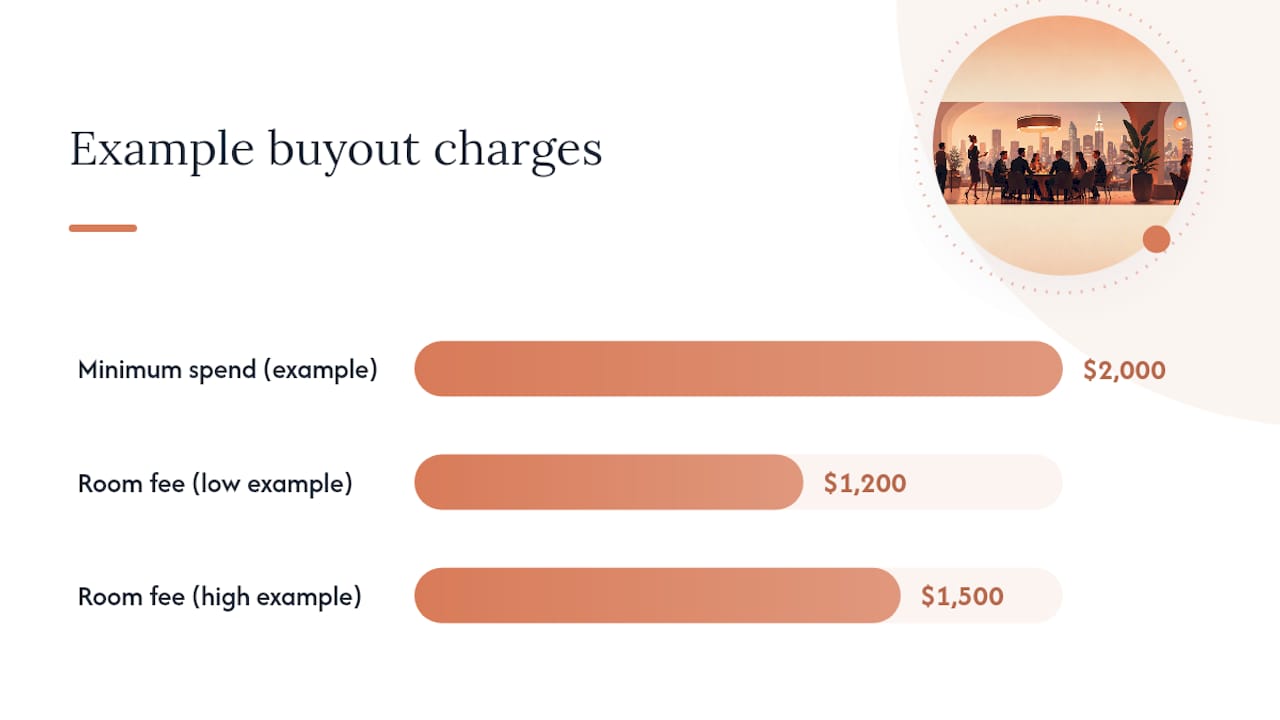
Here’s a conceptual example. Say a venue quotes a $2,000 food-and-beverage minimum for a Tuesday evening semi-private room. If that same venue instead offered a room fee model, the equivalent charge might land closer to $1,200 to $1,500 flat, with food and beverage billed separately at full menu pricing. Neither structure is inherently cheaper. A minimum spend isn’t automatically more expensive than a room fee; the right choice depends on your group’s appetite, drinking habits, and how much you value flexibility over predictability.
A few distinctions worth keeping straight before you request proposals:
Minimum spend ties your cost to consumption. Heavy drinkers and multi-course orders help you hit the number naturally.
Room fee ties your cost to the space alone. It suits smaller or lighter-eating groups who don’t want to overorder just to satisfy a threshold.
Hybrid models exist too, particularly for full buyouts, where a base room fee is paired with a reduced minimum on top.
Ask which model a venue defaults to before requesting a quote. Some rooms only offer one structure.
How Much Do NYC Restaurant Buyout Minimums Typically Cost?
Pricing swings dramatically depending on the day of the week, the venue’s tier, and how much of the restaurant you’re actually taking over. For a private or semi-private room seating 20 to 40 guests on a non-prime weeknight, minimum spends for private events typically range from $1,500 to $5,000, with the lower end reserved for early seatings and Monday through Wednesday bookings.
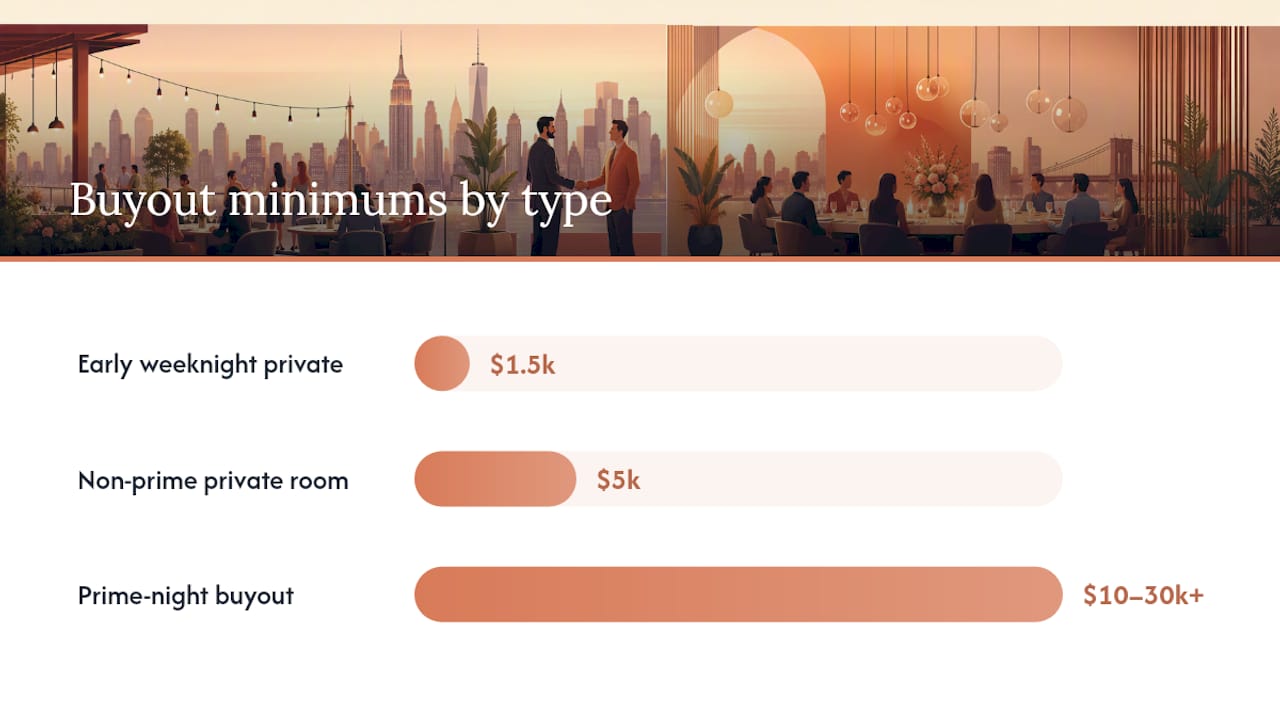
Full or near-full buyouts on Friday or Saturday nights live in an entirely different tier. Private-dining minimums commonly reach $10,000 to $30,000 or more for prime-night rooms or marquee buyouts, particularly at venues with name recognition, skyline views, or a chef with a following. Holiday weeks, especially December and wedding season weekends from May through October, push those figures toward the upper range or beyond.
Four variables move the number more than anything else:
Neighborhood and venue tier. A buzzy West Village bistro and a Midtown institution with a private ballroom operate on entirely different pricing tiers, even at comparable capacity.
Time slot. Early seatings (5:00 to 6:30 PM) routinely carry lower minimums than 8:00 PM prime-time slots, since the venue is sacrificing less walk-in revenue.
Day of week. Sunday and Monday minimums often run 30 to 50 percent below Friday and Saturday pricing at the same venue.
Calendar timing. Holiday parties in December, graduation season in May and June, and peak wedding weekends compress availability and push minimums toward their ceiling.
If you’re weighing a private room against taking over the entire space, remember that private rooms carry fixed seating capacity, which means once your guest list exceeds that room’s limit, a full buyout often becomes the only realistic option, regardless of the higher minimum attached to it.
What Counts Toward the Minimum, and What Gets Added on Top?
This is where most first-time hosts get caught off guard. A minimum spend generally applies to food and beverage purchases, including preordered set menus, wine packages, and consumption at the bar. What it typically does not include is just as important:
New York State sales tax, currently applied on top of the food and beverage total.
Service charge or auto-gratuity, commonly 20 to 22 percent, layered on after the minimum is calculated.
Administrative fees, which some venues bundle separately from gratuity.
AV rental, floral upgrades, and specialty linens, almost always billed as add-ons.
Cake-cutting or corkage fees, if you’re bringing in outside elements.
Whether a venue quotes its minimum pre-tax or post-tax changes the real number dramatically, and the wording is easy to miss on a one-page proposal. A $15,000 minimum that excludes a 22 percent service charge and roughly 8.875 percent sales tax effectively becomes a bill closer to $19,500 before you’ve ordered a single hors d’oeuvre. Hosts should always ask venues directly whether gratuity is calculated on top of the minimum or included in it, since this single line item causes the most disputes at final invoicing.
Don’t accept a verbal explanation of what’s included. Insist on a written breakdown and a sample invoice showing the minimum, applicable fees, tax, and gratuity laid out separately, so you can compare quotes across venues on equal footing rather than guessing which one is actually the better deal.
How Do You Turn a Venue Minimum Into a Real Budget?
The quoted minimum is never the number you’ll actually pay. Bonnie Rae’s planning teams consistently add 30 to 35 percent to a venue’s quoted minimum to account for tax, service charge, administrative fees, and the small incidentals that appear on nearly every private-event invoice. Use 30 percent for straightforward bookings with a fixed menu and minimal customization. Use 35 percent, or add a further 5 to 10 percent contingency, when the event involves last-minute menu changes, extended hours, or guest-requested upgrades, all common at UHNW and celebrity gatherings.
Staffing assumptions matter just as much as the food math. For luxury events, plan on roughly one bartender per 35 to 50 guests to keep service pace appropriate for a discerning guest list. Larger buyouts, or any event with a cocktail hour separate from dinner service, typically need dedicated event staff or butlers on top of the venue’s house team.
Here’s how that math plays out on a $10,000 minimum:
Start with the quoted minimum: $10,000.
Add 30 to 35 percent for tax, service charge, and administrative fees: roughly $3,000 to $3,500.
Layer in dedicated staffing beyond the house team, bartenders, floor captains, or a butler for a VIP table, typically $1,500 to $3,000 depending on headcount.
Add a conservative 5 to 10 percent contingency for last-minute additions: another $500 to $1,000.
Realistic all-in total: roughly $15,000 to $17,500.
Pro Tip: Never present a client or family with the bare minimum number. Build the all-in figure first, then present that as the budget, so nobody is surprised by the invoice that lands three weeks after the event.
Can You Negotiate a Restaurant Buyout Minimum?
Minimums are far more flexible than most first-time hosts assume, and venues will move on them when you give them a reason to. Private-dining minimums are genuinely negotiable on soft dates, and flexibility on timing or menu structure tends to produce the most meaningful discounts.
A few levers that consistently work:
Offer soft-date alternatives. January, August, and most Sunday-through-Tuesday slots see lower demand, and venues will often shave 15 to 25 percent off a prime-night minimum to fill a quiet week.
Accept structural tradeoffs. A fixed set menu, a shortened service window, or partial rather than full exclusivity almost always brings the minimum down, since it reduces the venue’s own risk and staffing burden.
Negotiate credits, not just discounts. Ask whether AV setup, coat check, or a menu tasting can be rolled into the minimum instead of billed separately.
Request a host bar cap. Capping bar spend at a fixed number per guest protects your budget while still letting the venue count that spend toward the minimum.
Venues care more about predictability than headline price. A host willing to commit early, confirm a final headcount promptly, and lock in a set menu is often a more attractive booking than one chasing the lowest possible number.
What Should You Confirm Before Signing a Buyout Contract?
A polished proposal can still hide costly ambiguity. Before signing, walk through this checklist line by line:
Deposit amount and refundability. Deposits typically run 25 to 50 percent of the food-and-beverage minimum, and higher-tier rooms often require nonrefundable deposits at signing. Confirm the exact percentage and cancellation window in writing.
What counts toward the minimum. Get an itemized list confirming whether tax and gratuity are included in the stated figure or added afterward.
Under-spend policy. Ask exactly how a shortfall gets invoiced if your group doesn’t hit the minimum, and whether unused spend can be applied to add-ons like floral or AV.
Overtime fees. Confirm the hourly rate if your event runs past its contracted end time, a common and often steep line item.
Vendor access windows. Clarify when your florist, photographer, or entertainment can load in and whether the venue restricts outside vendors entirely.
Final headcount deadline. Most venues require your guaranteed guest count 72 hours before the event, after which you’re billed for that number regardless of no-shows.
Payment schedule. Confirm the balance due date, typically at signing, 30 days out, and day-of.
What Do Real Buyout Budgets Look Like at Different Guest Counts?
Numbers matter more than theory here, and per-head math changes shape as your guest list grows.
20 guests, weekday semi-private room: A $2,000 to $3,000 minimum, all-in around $2,800 to $4,100 after the 30 to 35 percent add-on, roughly $140 to $205 per head.
40 guests, small buyout or full semi-private takeover: A $6,000 to $8,000 minimum, all-in around $8,400 to $11,000, roughly $210 to $275 per head once staffing is layered in.
80 guests, full weekend buyout: A $20,000 to $30,000 minimum, all-in $27,000 to $41,000 once dedicated staff, AV, and full exclusivity are added, often $340 to $510 per head. The per-head math frequently favors a full buyout at this scale, since exclusivity and staffing costs spread across more guests.
What Happens if Your Group Doesn’t Hit the Minimum?
Every buyout contract should spell out exactly what happens if your final bill falls short of the stated minimum, and this clause deserves as much scrutiny as the price itself. Most NYC venues bill the difference as a flat line item on the final invoice, meaning a group that spends $8,200 against a $10,000 minimum gets charged the remaining $1,800 regardless of consumption.
Deposit structures vary by venue and date, but expect to pay 25 to 50 percent of the minimum at signing, often nonrefundable within a set window before the event, typically 30 to 60 days out depending on the room’s popularity. Cancellations further out sometimes recover a partial deposit; cancellations inside that window rarely do.
Ask specifically how the venue treats a shortfall: does it convert into credit toward add-ons like floral upgrades or extended hours, or is it simply forfeited? Some venues will let you apply excess deposit toward gratuity or AV rental if your consumption comes in under the minimum. Others treat it as a straightforward loss. Get this answer in writing before you sign, not after the final invoice arrives.
When Should You Bring in a Full-Service Event Producer?
A buyout minimum tells you what the venue expects you to spend. It doesn’t tell you what actually makes an event feel effortless, seamless staffing, discreet entrances, a bar program that never backs up, florals that arrive on time and on brief. That’s where the math stops being the interesting part of the story.
Complexity is the real trigger for bringing in a producer. If you’re hosting a celebrity, an athlete, or a group of UHNW guests where optics and discretion matter as much as the menu, or if you’re coordinating six or more vendors across florals, staffing, AV, and entertainment, doing it solo off a venue’s banquet-event order is a genuine risk. Bonnie Rae builds extraordinary hospitality experiences specifically for ultra-high net worth individuals, corporate clients, discerning executives, athletes, and cultural icons, which means the buyout minimum becomes one line in a much larger production plan rather than the entire plan itself.
— Bonnie Rae
Where Can You Read More on NYC Buyout Pricing?
Minimum spend vs. room fee, explained — pricing structures and inclusions.
Private dining booking guide — deposits and negotiation norms.
Liquor licensing overview for NYC buyouts — legal and timeline constraints.
Bonnie Rae — full-service luxury event production.
Sources
Recommended
Comments