
Guest Experience Design: The Revenue System Behind Luxury Stays
Guest experience design is the deliberate architecture of sensory, spatial, and service details that shapes what a guest feels, remembers, and pays for. Done well, it moves the needle on ADR, direct bookings, and loyalty, because guests who feel understood return, spend more on-property, and tell people like them where to stay. Three priorities separate the properties that get this right from those still decorating lobbies and calling it strategy.
Clarify positioning first. Know exactly which guest you are designing for before you choose a single fabric swatch.
Map the journey and pick three touchpoints. Full redesigns rarely work; three high-impact moments, done exceptionally, do.
Set one reproducible ritual and train staff to deliver it. Consistency, not spontaneity, is what guests remember as luxury.
Key Takeaways
Guest experience design functions as a measurable revenue system when positioning, journey mapping, and staff choreography are treated as commercial investments, not aesthetic ones.
Point | Details |
Positioning comes first | Define the exact guest you’re designing for before selecting materials or rituals. |
Three touchpoints beat a full redesign | Prioritize arrival, one in-stay moment, and departure for the highest return. |
Biophilic quality matters more than presence | Authentic, well-maintained natural elements raise perceived value and revisit intent. |
Staff execution decides consistency | Scripted boundaries with room for improvisation outperform rigid checklists. |
Bonnie Rae applies this through event production | Its briefing-to-follow-up process builds designed rituals for UHNW and VIP engagements. |
Table of Contents
What Are the Core Principles of Luxury Guest Experience Design?
How Do You Design the Guest Journey From Booking to Post-Stay?
How Should Luxury Properties Personalize the Guest Experience?
How Do You Translate Design Intent Into Consistent Staff Execution?
Applied Practice: How Bonnie Rae Builds Guest Experience Into Events
How Do You Localize Guest Experience for Different Cultures?
How Should Properties Collect and Act on Guest Feedback in Real Time?
What the Research Actually Tells Us About Guest Experience Design
What Are the Core Principles of Luxury Guest Experience Design?
Luxury guests register quality through layered sensory input, not any single grand gesture. Sight, sound, scent, and touch need to arrive in sequence, not all at once, the way a well-composed meal reveals itself course by course rather than dumping every flavor on one plate.
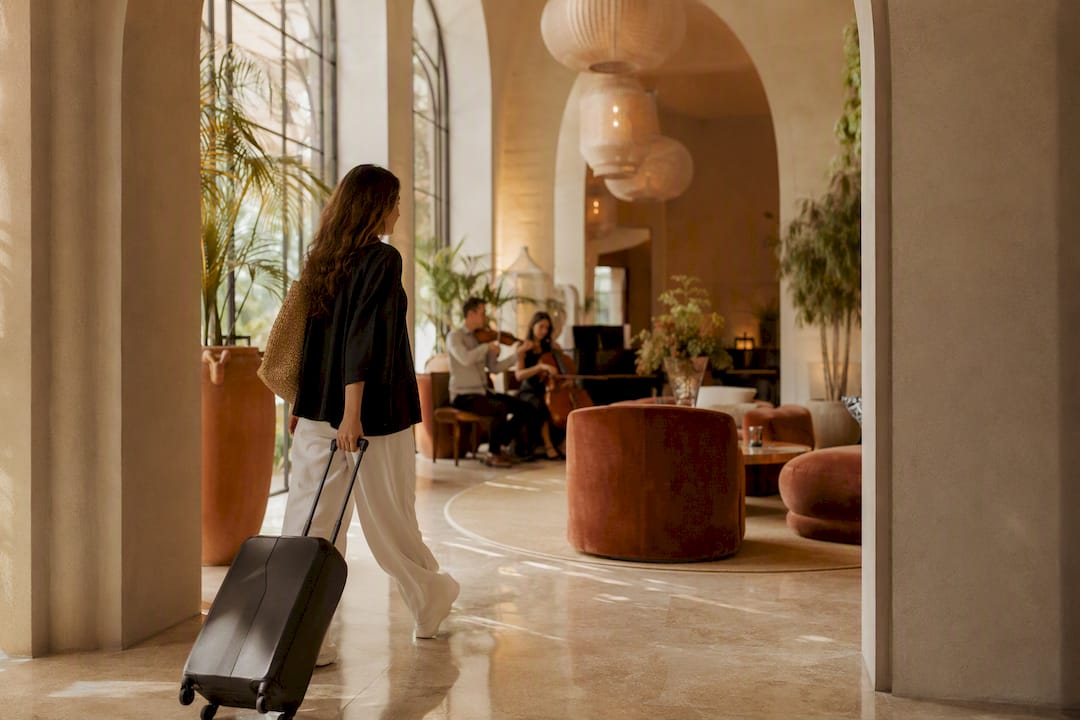
Arrival thresholds do more design work than almost any other square footage in the building. The moment a guest crosses from porte cochère to lobby should compress a wide, cluttered view into a single, deliberate sightline, the same principle stage designers use to draw an audience’s eye before the curtain even rises. WATG’s practice work on luxury hospitality design confirms that modern luxury increasingly favors sensory richness and nuance over sheer scale, and a well-composed arrival sequence is where that nuance shows first.
Material choices carry the story forward, but only if they wear well. Hand-troweled plaster and honed stone read as luxury on day one; they only stay that way if the maintenance plan is built into the specification, not bolted on after the first scuff mark.
Lighting and acoustics finish the job:
Layer lighting in at least three zones (ambient, task, accent) so a space can shift mood without renovation.
Favor warmer color temperatures in evening zones to respect circadian rhythm rather than fight it.
Treat acoustics as a privacy tool, not an afterthought; sound-absorbing materials near seating clusters let guests feel unheard by strangers ten feet away.
Even something as overlooked as a hotel lobby can become a genuine revenue center once it’s treated as a destination rather than a passageway, extending guest dwell time and pulling more F&B spend along with it.
Pro Tip: Walk your own arrival sequence at 4 p.m. on a Friday, the exact hour your busiest guests check in, and time how long it takes before a guest sees something worth pausing for. If it’s longer than 90 seconds, the sightline needs work before the décor does.
How Do You Design the Guest Journey From Booking to Post-Stay?
A guest journey blueprint works only when every stage has a named owner and a specific action, not a vague intention. Design-led hotel operators treat this chain, from positioning through pre-arrival communication to on-property delivery, as a direct driver of ADR and direct bookings, not a soft brand exercise.
Pre-arrival. Booking copy and photography should promise only what the property can deliver on its worst night, not its best press day. A short, selective personalization touch, confirming a preferred pillow type or a dinner reservation, sets expectations without over-promising.
Arrival. The first ten minutes decide the emotional tone of the entire stay. Queue management matters more than any welcome amenity; a guest standing in a line has already discounted the lobby scent and music you spent months selecting.
In-stay. Room cues (a handwritten note, a locally sourced snack) should feel incidental, not scheduled. F&B touchpoints carry real commercial weight here, and privacy has to win over programming by default; luxury guests want the option of activity, never the obligation.
Departure and post-stay. A crafted departure, a car ready without being asked, a small gift tied to something the guest mentioned, does more for review generation than any post-stay email. Follow-up messaging should solicit specific feedback and referrals within days, while the memory is still sharp.
Digital-physical alignment. Every promise made in a booking email or app notification needs a matching action on property. A practical primer on guest experience concepts is worth a read for teams still treating digital and physical service as separate departments.
How Should Luxury Properties Personalize the Guest Experience?
Personalization earns its keep only when it feels noticed, not surveilled. The most effective moves are quiet: a preference flag noting a guest dislikes down pillows, a returning-guest note referencing a conversation from eighteen months ago, a recurring gesture (the same welcome fruit, the same turn-down ritual) that builds recognition without demanding attention.
Surprise and delight work best when timing and cultural relevance align. A gesture that lands perfectly for one guest reads as tone-deaf for another; a birthday surprise means something different across generations and geographies, so the detail has to come from an actual guest profile, not a template.
Keep CRM flags simple: three or four fields (dietary notes, ritual preferences, past complaints) beat a twelve-tab profile nobody reads before a shift.
Let room automation stay invisible; guests should feel comfort, never notice the technology delivering it.
Build opt-in patterns into every data request, and be explicit about what’s collected and why; trust is the actual product being sold here.
Pro Tip: Train front-desk and concierge teams to add one new preference note per stay, not per year. A guest profile that grows slowly and specifically outperforms one built from a single intake form.
Does Biophilic Design Actually Increase Revenue in Hotels?
Recent peer-reviewed research says yes, but only when the biophilic elements are done well. A study surveying 428 hotel guests found that high-quality biophilic design significantly improves guest well-being, perceived value, and revisit intentions, and that guest delight strengthens those effects further.
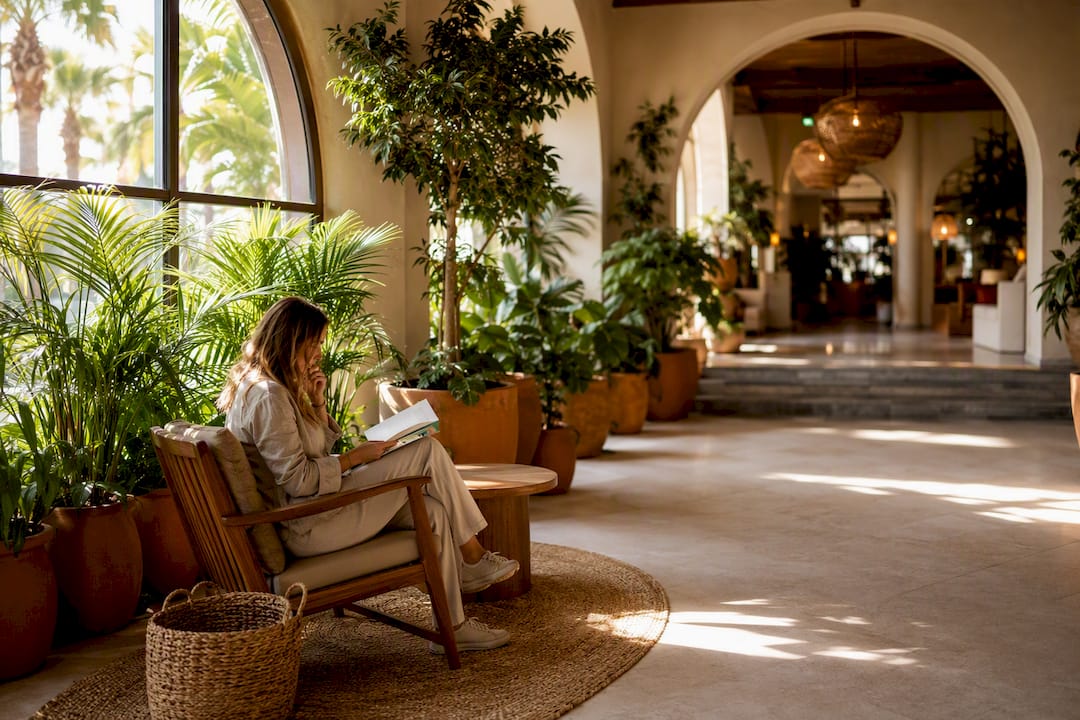
Quality, in this context, means authenticity, integration, and upkeep. A living wall that looks staged, or one that’s dying by month three, does more reputational damage than no greenery at all.
The commercial case gets stronger once you factor provenance. A single sentence on a room card (“This olive branch was harvested from the property’s own grove”) turns a plant into a story, and stories justify premium pricing in ways décor alone cannot.
Practical moves that scale across property types include maximizing natural light in public spaces, curating seasonal plantings tied to the local climate rather than importing exotic species, and building small seasonal installations that give returning guests a reason to notice change. Sustainability, framed correctly, becomes a luxury signal rather than a compromise.
How Do You Translate Design Intent Into Consistent Staff Execution?
Design only becomes guest experience once staff can execute it under pressure, at 11 p.m., with a fully booked house, without a supervisor standing over their shoulder. Academic work on scenography borrows a useful metaphor from jazz: give staff a clear structure, then let them improvise within it, the same way a chord progression frees a musician rather than constraining them.
Write scripts as boundaries, not scripts. Define what must happen (a guest’s name used within the first exchange) and leave room for how.
Build a staffing model around cadence, not headcount alone. Know exactly who greets, who follows up, and when the handoff happens.
Govern quality with light-touch QA. Spot-check ten interactions a week rather than auditing every shift; over-monitoring kills the improvisation you just gave staff permission to use.
Choose your complexity deliberately. Every added ritual costs training time and consistency risk; a defensible scope beats an ambitious one that only works when your best staff are on shift.
Pro Tip: Pilot any new ritual with your strongest team for two weeks before rolling it property-wide. If they can’t make it feel natural, no one can.
How Do You Measure ROI From Guest Experience Design?
Design investment only holds up in a budget meeting when it’s tied to numbers finance actually tracks. Three categories cover most of what matters.
Commercial: ADR uplift, direct booking mix, RevPAR, F&B capture rate, average dwell time in public spaces.
Experience: NPS, frequency of specific review themes (staff warmth, arrival, cleanliness), repeat-booking rate, sentiment tags from guest messaging.
Operational: service-consistency scores from mystery-shop audits, staff training completion rates, maintenance reliability on design elements like lighting and plantings.
Metric Category | Example Metric |
Commercial | ADR uplift after a redesigned arrival sequence |
Commercial | F&B capture rate tied to lobby redesign |
Experience | NPS shift following a new departure ritual |
Operational | Staff training completion rate for new service script |
A small pilot beats a full rollout every time. Test one ritual in one wing or one shift, track the metrics above for six to eight weeks, and let the data, not the design brief, make the case for scaling.
Applied Practice: How Bonnie Rae Builds Guest Experience Into Events
Bonnie Rae’s process for ultra-high-net-worth and VIP engagements follows a tight sequence: briefing, scenography, staffing, execution, follow-up. Each stage exists to protect the same outcome, a guest who feels the event was built specifically for them.
The difference between a memorable event and a forgettable one rarely comes down to budget. It comes down to whether every touchpoint, from the first email to the last handshake, was designed on purpose.
For athlete and executive clients, this often means concierge-level dining coordination built around nutrition needs and travel schedules, alongside vetted staffing trained to read a room rather than follow a rigid checklist. Readers can see the range of that work across the Bonnie Rae blog, where additional case examples and event insights are documented.
How Do You Make Guest Experiences Accessible and Inclusive?
Accessibility in luxury settings is too often treated as a compliance checkbox rather than a design input, and that mistake shows up fast in guest reviews. A wheelchair user navigating a beautifully lit lobby with no clear path around a sculptural centerpiece doesn’t experience luxury; they experience an obstacle course with good lighting.
Build accessibility into the earliest design conversations, not the punch list. That means door widths and turning radii for mobility devices, contrast-sensitive signage for low-vision guests, and at least one sensory-quiet space for guests who find high-stimulation lobbies overwhelming. Staff training matters as much as physical specification; a concierge who knows how to offer help without assuming it’s needed does more for a guest’s dignity than any ramp.
Inclusivity extends to family structures, dietary needs, and religious observance. A prayer space noted quietly on a guest profile, a children’s turn-down ritual that doesn’t feel like an afterthought, a menu that flags allergens without making a guest ask twice, all of these signal that the property designed for the guest in front of them, not an assumed default guest. Bonnie Rae’s own accessibility statement reflects the same principle: inclusive design is a stated commitment, not a footnote.
The properties that get this right treat accessibility as a design constraint that sharpens creativity, the same way a strict color palette sharpens a designer’s choices rather than limiting them.
How Do You Localize Guest Experience for Different Cultures?
A ritual that delights one guest can offend another, and the gap is almost always cultural, not personal. Gift-giving customs, dietary restrictions tied to religious observance, and even the appropriate amount of eye contact during a welcome greeting vary widely across the international guest base a luxury property typically serves.
Start with research, not assumption. Know which regions send the most guests to your property and build a working knowledge of common customs, preferred communication styles, and hospitality norms for each. A staff briefing sheet covering the top five source markets does more practical good than a generic diversity training module.
Localization also means language access at the moments that matter most: arrival, dining, and any medical or safety communication. A menu translated poorly, or a concierge who can’t confirm a dietary restriction in a guest’s preferred language, creates real risk, not just discomfort.
The subtler work is calibrating warmth itself. Some guests expect effusive, personal engagement from staff; others read that same warmth as intrusive and prefer quiet efficiency. Reading that signal correctly, often within the first exchange, is a skill worth training explicitly rather than leaving to instinct.
How Should Properties Collect and Act on Guest Feedback in Real Time?
Waiting for a post-stay survey to learn something went wrong is a design failure in itself. The properties that correct course fastest build feedback collection into the stay, not just the exit.
Simple, low-friction channels work best: a direct text line to a guest services lead, a QR code at turn-down that opens a two-tap satisfaction check, or a daily check-in call for suite-level guests. The goal is catching a problem, a noisy room, a missed dietary note, within hours, not weeks.
Real-time adjustment requires staff empowered to act without escalation for small fixes. A front-desk agent who can move a guest to a quieter room without three layers of approval solves the problem before it becomes a review. Save formal reviews and NPS surveys for the pattern-level insight; use in-stay channels for the moment-level fix.
Track feedback themes weekly, not quarterly. A recurring complaint about restaurant noise levels that surfaces in five stays across one month is a design signal, not a coincidence, and it deserves faster action than the standard quarterly design review would allow.
What the Research Actually Tells Us About Guest Experience Design
Most advice on this topic treats guest experience as a mood board exercise: pick a scent, choose a color palette, call it done. The peer-reviewed evidence doesn’t support that shortcut. Biophilic design only moves the needle when it’s authentic and maintained, which means the real cost center isn’t the initial installation, it’s the ongoing upkeep budget most properties quietly skip.
The bigger blind spot is staffing. Properties pour money into arrival scenography and then hand execution to a rotating cast of undertrained staff with no room to improvise inside a script. The scenography-and-improvisation research points to a better model: fewer rigid rules, clearer boundaries, and staff trusted to fill the gaps.
If there’s one place to start, it’s the journey map, not the mood board. Pick three touchpoints, fix those completely, and resist the urge to redesign everything at once. Depth beats breadth every time in this category.
— Bonnie Rae
Bring Guest Experience Design to Your Next Event
Bonnie Rae is the option for hosts and organizations who want this level of design thinking applied to a single event, not a year-long property renovation. Where a hotel redesign takes months of capital planning, an event gives you the same sensory sequencing, journey mapping, and service choreography compressed into one night, with every touchpoint, from the first invitation to the final departure, built around the specific guest in front of you.
This is the work Bonnie Rae does for ultra-high-net-worth individuals, professional athletes, executives, and cultural icons who need an event that reads as effortless because it was designed to. Venue scouting, staffing, catering, florals, and full production come together under one team, so nothing gets lost between the brief and the execution. Browse the portfolio to see the range of work, or visit Bonnie Rae to start a conversation about your next event.
Sources
Recommended
Comments